The MTA's Light Rail Modernization Program (LRMP) is an investment to deliver more reliable, faster, safer, and more accessible service for Light Rail riders. The LRMP is a more than $1.5 billion program of investments in state of good repair of Baltimore’s Central Light Rail system that will bring new modern light rail vehicles, upgrade signal systems, stations, track segments, and maintenance facilities.
Why Modernize the Light Rail?
The Light Rail system has not been modernized since the initial construction in the 1990’s. The federal grant received in 2024 to replace MTA’s current Light Rail vehicles is an opportunity to modernize the entire Light Rail system that is only presented once every several decades. Additional state funding complements the federal grant to fully fund the overall modernization program. It’s time to invest in the state of good repair of our Light Rail system to meet the needs of our growing, connected city.
Planned improvements
New Vehicles
Modern, low-floor Light Rail vehicles.
Station improvements
ADA investments at all 33 Light Rail stations.
Track upgrades
Upgraded tracks, grade crossings, and replacement of track in the Central Business District.

Maintenance and facility upgrades
Retooled maintenance and storage facilities.
Power and system upgrades
Replacement of the traction powered substations that keep the trains moving.
How will this improve my ride?
Rider Benefits
Shorter waits
More Light Rail trains will provide more frequent service than today.
Easier boarding
The vehicle floor and station platform will be the same height, allowing riders to get on and off without stairs or ramps.

More reliable service
Upgrades to tracks, power systems, signals, and maintenance facilities will reduce delays and service issues.
Better stations
Refreshed stations will be more accessible, comfortable, and easier for everyone to use.
Program Implementation
The LRMP spans 33 stations from Hunt Valley in Baltimore County, through Baltimore City, to BWI Airport and Glen Burnie in Anne Arundel County. The LRMP will be delivered under four separate projects, each with their own contract.
| Contract | Overview |
|---|---|
| Contract 1: Light Rail Vehicle & Advanced Train Controls |
|
| Contract 2: Light Rail Stations and Track |
|
| Contract 3: Cromwell Maintenance and Storage Facility Modernization |
|
| Contract 4: Traction Power Station Upgrades |
|
What’s Happening Now?
Procurement
The MTA has active solicitations posted through eMaryland Marketplace Advantage (eMMA), the official website used by the MTA to solicit construction contracts. A snapshot of the MTA's upcoming procurements can be found at the MTA's procurement webpage.
Stakeholder Engagement
The MTA is coordinating with local agency partners to develop a stakeholder engagement and communication plan that includes early and frequent communication of LRMP activities. Leading up to and during the construction phase, detailed information on upcoming construction activities will be shared with stakeholders. Information about construction activities will be site-specific and frequently updated to help communicate the potential effects to the communities and businesses that neighbor the Light Rail system.
Anticipated LRMP Timeline
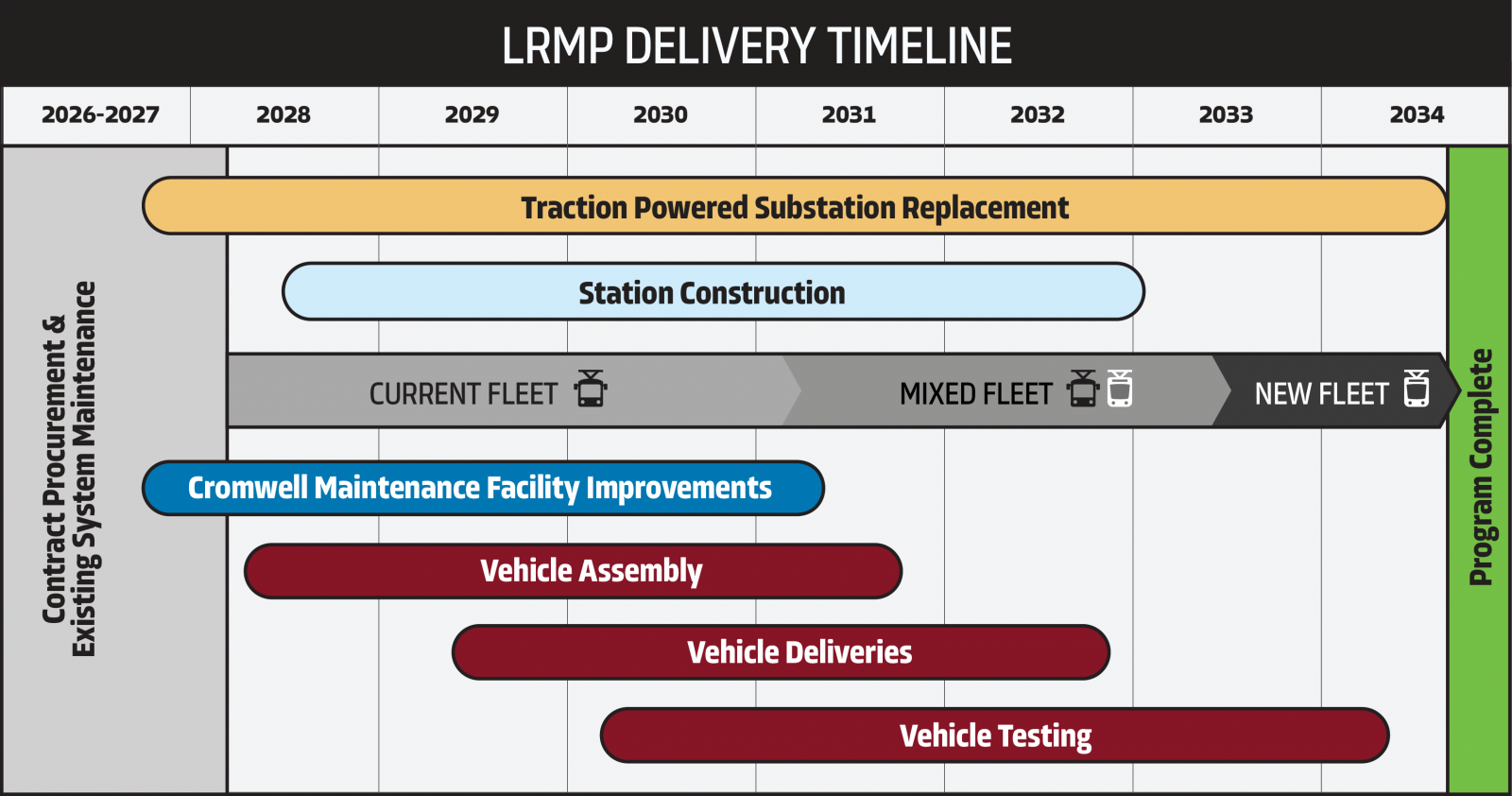
Detailed description the timeline graphic
The overall timeline for LRMP begins in 2026 and ends in 2035.
| Dates | Activities |
|---|---|
| 2026 to 2028 | Contract Procurement and Existing System Maintenance |
| 2027 to 2034 | Traction Powered Substation Replacement |
| 2027 to 2031 | Cromwell Maintenance Facility Improvements |
| 2028 to 2033 | Station Construction |
| 2028 to 2031 | Vehicle Assembly |
| 2029 to 2032 | Vehicle Deliveries |
| 2030 to 2034 | Vehicle Testing |
| 2026 to 2031 | Current Fleet Operations |
| 2031 to 2033 | Mixed Fleet Operations |
| 2033 to 2034 and beyond | New Fleet Operations |
| 2034 to 2035 | Program Complete |
Note: The LRMP timeline is subject to further refinement as procurement progresses and collaboration with program delivery partners continues.
The MTA anticipates awarding contracts for design and construction by Spring 2027. These contractors will compete to propose the best project timelines that minimize cost, reduce construction impacts, and maintain light rail service throughout the program implementation. While the specific timeline will not be known until the contractors have been selected and awarded a contract, the MTA anticipates the new vehicles will be phased into service, resulting in a period of time with a mixed fleet of current and new vehicles. The MTA anticipates that an initial station construction phase will enable mixed-fleet operations, and a second station construction phase will prepare for the fully new fleet operations.
Frequently Asked Questions
- iWhat is the Light Rail Modernization Program (LRMP)?
-
The LRMP is a program of over $1.5 billion of investments in light rail vehicles, signal systems, station rehabilitation, and track and maintenance facility improvements. The program includes replacing 52 light rail vehicles with fully accessible modern low-floor vehicles, updating signal and train control systems, improving all 33 light rail stations, and upgrading maintenance facilities to support the new vehicles.
- iWhy modernize the Central Rail Line?
-
Light Rail vehicles and infrastructure haven’t been updated or modernized since the system’s initial construction in the 1990s. This has resulted in negative customer experiences including long wait times for trains to arrive and depart stations and slow trips through downtown Baltimore. The LRMP will address these deficiencies and provide an improved customer experience.
- iWhat benefits will riders experience?
-
Riders will experience shorter waits, easier boarding, more reliable service, and better stations. Upgraded operations equipment and increased vehicle availability will allow trains to operate more frequently.
- iWhen will the implementation timeline be known?
-
Two key drivers for the LRMP timeline are: (1) the time required to build, deliver and test the new rail cars, and (2) the construction timelines for the station improvements. The MTA will better understand the vehicle and station timelines after contractors are selected and awarded contracts.
- iHow will the LRMP be funded?
-
The LRMP is funded through a $213 million Rail Vehicle Replacement grant from the federal government, which will allow MTA to replace the light rail vehicles, and over $1 billion in federal and state funding, which will allow the MTA to upgrade stations and facilities and implement power and system upgrades.
- iWill the LRMP create jobs or increase access to jobs?
-
The LRMP is expected to create numerous construction jobs and bolster support for new and existing businesses along the corridor. The light rail route and areas served will not be changing. However, a faster, more reliable light rail trip will make taking light rail to job centers along the corridor more practical.
- iHow will this project help revitalize Howard Street?
-
The LRMP will provide modernized light rail service on Howard Street, with brand new vehicles, station improvements, track upgrades, and power and system upgrades. The upgrades in the stations will include things like improved lighting, CCTV cameras, and improved wayfinding that will improve the experience for riders. With a brand new fleet of light rail vehicles, the MTA expects increased train frequencies along Howard Street that will help people move more quickly to and through the corridor. The LRMP team is working with Baltimore City to identify priorities for additional locally-led investments along Howard Street that can complement the LRMP’s investment in the Light Rail infrastructure.
- iWill the LRMP straighten out the tracks along Howard Street?
-
No, the LRMP does not include any realignment of the light rail tracks along Howard Street. However, the MTA is coordinating with the Baltimore Department of Transportation and corridor stakeholders to explore changes to traffic patterns that will remove conflict-points between cars and light rail vehicles, improve pedestrian safety, and help the light rail vehicles move more quickly through downtown.
- iHow does this project relate to the Red Line?
-
The two projects are being planned in coordination so that they result in a strong transit network for the Baltimore region. However, the funding sources, design and construction activities are independent. The LRMP team will continue coordinating with the Red Line team on technical details such as vehicle specifications and station design so that the two projects are part of a connected transportation system.
- iHow will Light Rail service be impacted during construction?
-
The MTA will work with the contractors to develop an implementation schedule that supports customer convenience and construction efficiency. Construction will be completed in phases to minimize interruptions to light rail service. The MTA will announce and publicize interruptions to light rail service in advance and will provide alternative service options, such as bus bridges, when needed.
- iHow will MTA communicate with transit riders, drivers, and adjacent property owners or businesses about construction impacts?
-
The MTA will provide frequent updates to transit riders, residents and businesses adjacent to the light rail alignment, and also to the broader Baltimore community. Updates will be provided in person to corridor neighbors and online through the project webpage, MTA social media, and LRMP newsletters.
Learn More
Recent Presentations
Please click the links below to view recent presentations regarding the LRMP:
Industry Day with MTA
The Maryland Transit Administration hosted an “Industry Day” in June 2025 to provide prime contractors, subcontractors, suppliers, and other interested businesses an opportunity to learn more about the Light Rail Modernization Program and associated program timelines.
View Materials from Industry Day.
Subscribe for Information
Please provide contact information below to subscribe to periodic updates about the LRMP.
Contact the Team
If you have questions about the Light Rail Modernization Program, please contact the project team.
Email: lightrailmodernization@mta.maryland.gov
Phone: 410-767-9099
For more information, or to request this document in an alternate format or translated into another language, please contact the department listed below.
MDOT MTA Transit Information Contact Center • 410-539-5000 • 866-743-3682 • TTY 410-539-3497 • Maryland Relay Users Dial 7-1-1